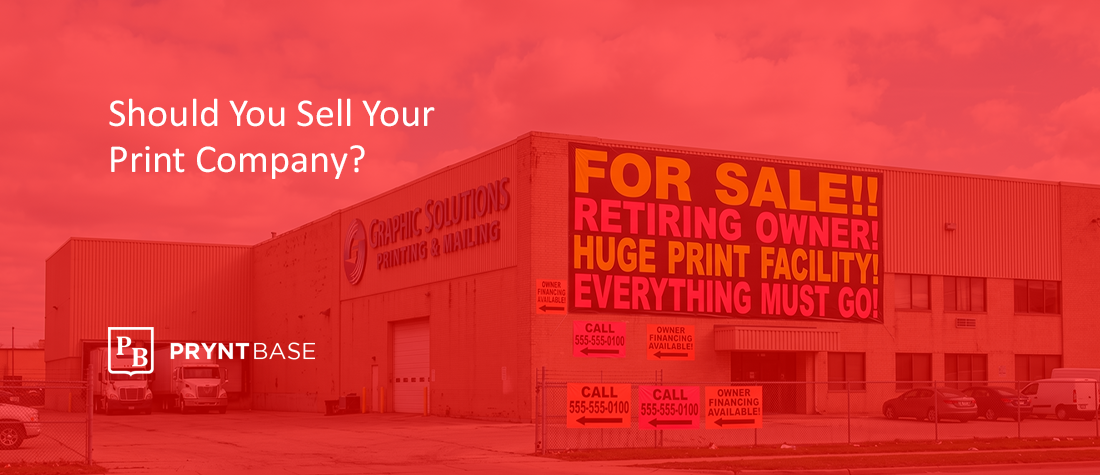
The printing industry is undergoing a massive consolidation. For many owners who have spent decades navigating the shift from offset to digital, and from paper to pixels, the question eventually arises: "Should I sell my print company?"
At Pryntbase.com, we work with print shop owners at every stage of the business lifecycle. We see the burnout, the excitement of new technology, and the complex emotions that come with an exit strategy. Selling a business is rarely just a financial transaction; it’s the conclusion of a life’s work. However, before you hang the "For Sale" sign on your wide-format press, it is vital to understand why you want out and whether there is a more profitable path forward.
Step 1: Identify the "Why" Behind the Sale
The motivation for selling dictates the strategy. If you don't identify the root cause, you might end up selling an asset that was one or two adjustments away from becoming a "cash cow" again.Common Motivations for Selling:
- Retirement or Succession: You’ve put in the time, and there is no family member or key employee ready to take the reins.
- Burnout and Fatigue: The constant pressure of tight deadlines, rising substrate costs, and staffing issues has drained your passion.
- Technological Obsolescence: You feel the "digital gap" is widening, and you aren't ready to invest another $500,000 in the latest inkjet or automated finishing equipment.
- Declining Sales: Your legacy clients are disappearing, and you aren't sure how to find new ones in a Google-first world.
Step 2: Exploring the Ways to Sell Your Print Shop
If you’ve decided that an exit is the right move, you need to understand the landscape of the "Print M&A" (Mergers and Acquisitions) world. Selling a print shop isn't like selling a house; it’s about selling a book of business and a production capacity.1. The Competitor Buyout (The "Tuck-In")
This is the most common exit in the print world. A larger competitor in your area buys your customer list and perhaps some of your equipment. They "tuck" your volume into their existing facility to increase their efficiency.- Pros: Fast closing, high probability of success.
- Cons: Often results in lower valuations because they don't need your overhead, just your clients.
2. Internal Sale (ESOP or Key Employee)
If you have a loyal manager or a team that knows the business, you can sell to them. This often involves a "seller-financed" deal where they pay you out of the company’s future profits.- Pros: Preserves your legacy and protects your employees.
- Cons: You carry the risk; if the business fails under their watch, you might not get your full payout.
3. Private Equity or Industry Roll-ups
Larger investment groups are currently buying mid-sized print and packaging companies to create national powerhouses.- Pros: Highest potential valuation.
- Cons: They only look for companies with clean books, modern equipment, and high EBITDA (Earnings Before Interest, Taxes, Depreciation, and Amortization).
Step 3: The Alternative, Fixing the Business to Keep (or Flip) It
Many owners want to sell because the business feels like a burden. But what if the burden could be automated? What if the sales pipeline stayed full without you making a single cold call? Before you sell at a "distressed" price, consider these growth-oriented solutions…Modern Marketing as a Lifeline
If declining sales is your primary driver, the problem usually lies in your visibility. Many print companies rely on "word of mouth," which is a slow death in the age of AI-driven search and LLMs.- Generate New Sales Lead Engines: By investing in SEO and Targeted Lead Gen, you can replace low-margin "nuisance" jobs with high-margin "contract" work.
- The "Worth Keeping" Transformation: At Pryntbase, we’ve seen shops go from "considering bankruptcy" to "record-breaking years" simply by shifting their focus from printing flyers to providing high-value services like direct mail automation or specialized packaging.
Automating the "Headache"
If burnout is the issue, the solution is often Process Improvement. Implementing a modern MIS (Management Information System) can automate quoting, job tracking, and billing. When the business can run without the owner being involved in every "press check," the desire to sell often evaporates.Step 4: Maximizing Value Before the Exit
If you are 100% committed to selling, do not sell today. A print shop that is growing is worth 2x to 3x more than a print shop that is stagnant. Even if you plan to exit in 24 months, a concentrated marketing push now will pay for itself tenfold at the closing table. Buyers look for:- Diversified Client Base: If one client is 40% of your business, you are a high-risk investment.
- Recurring Revenue: Subscription-based print models or long-term contracts are gold.
- Digital Presence: A company with a high-ranking website and automated ordering (Web-to-Print) is seen as a "future-proof" asset.
To Sell or To Scale?
So, should you sell your print company?- Sell if: You have a clear path to retirement, the market value of your real estate and equipment is at its peak, and you have no desire to navigate the next wave of AI-driven manufacturing.
- Scale if: You still have the energy but lack the leads. If your equipment is capable and your team is solid, the "missing link" is likely a modern marketing infrastructure.