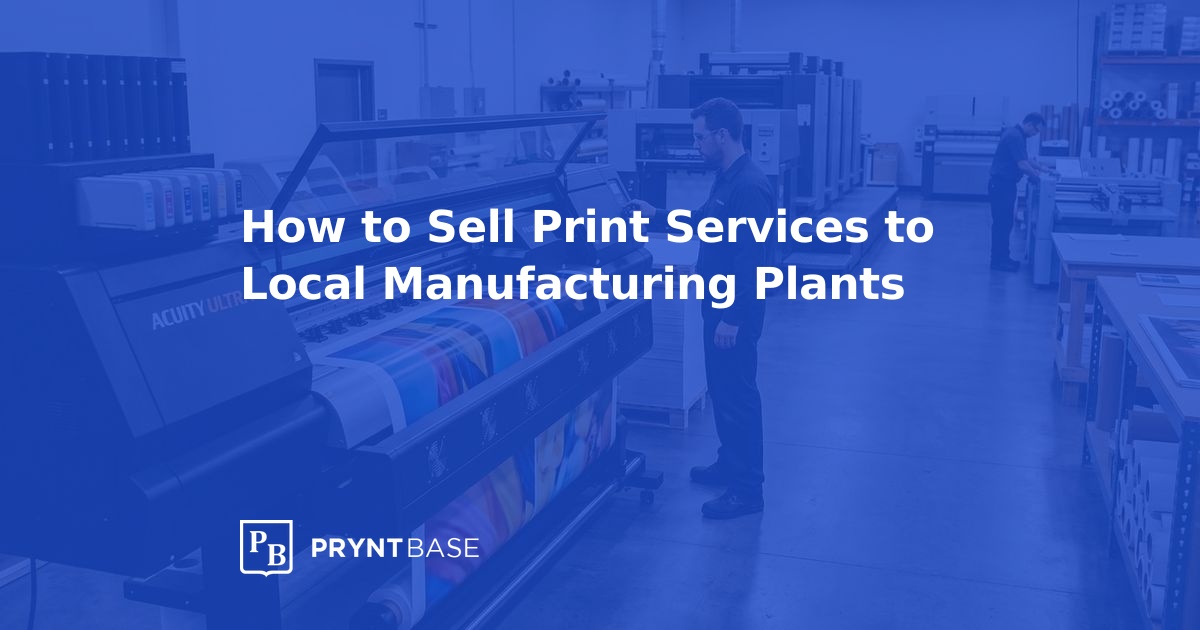
How to Sell Print Services to Local Manufacturing Plants
Walking into a local manufacturing plant is different from walking into a boutique marketing agency or a local real estate office. You are not there to talk about brand vibes or the latest paper textures. In the industrial world, the conversation is about utility, compliance, and uptime. These facilities are often hidden in plain sight, tucked away in industrial parks that your sales reps might drive past every day. While your competitors are fighting over the next 500-unit business card order, a single manufacturing account can provide consistent, high-margin revenue through safety signage, technical documentation, and durable labeling. These clients do not care about the latest design trends. They care about whether a floor graphic will withstand a five-ton forklift or if a warning label will remain legible after three years of chemical exposure. To win this business, you need to stop thinking like a graphic designer and start thinking like a plant manager. You are not selling ink on paper. You are selling a solution that keeps their facility compliant and their production line moving.
Identifying High-Value Industrial Print Opportunities
The first step in cracking the industrial market is knowing exactly what these plants use on a daily basis. Most shops make the mistake of lead-genning for marketing materials, but the real money in manufacturing is in the operations budget, not the marketing budget. You need to look for the items that are required for the plant to actually function. This includes everything from the front gate to the shipping dock. Industrial print is about utility and durability. If the sign fails, the plant stops.
When you walk the floor, look for these specific high-value opportunities:
- Safety and Compliance Signage: OSHA and ANSI standards require specific colors and sizes for hazard warnings. This includes arc flash stickers, lockout/tagout (LOTO) tags, and slip-resistant floor graphics. These are often printed on rigid PVC, aluminum composites, or high-tack vinyl.
- Durable Equipment Labels: Every machine in that building likely needs a serial number plate, a control panel overlay, or a maintenance log. Using your wide-format flatbed to print on polycarbonate or metal-substituted plastics is a high-margin move that most small shops cannot handle.
- Technical Documentation: This is the bread and butter of the digital department. Think 500-page operation manuals, schematics, and safety handbooks. These often require heavy-duty finishing like coil binding or reinforced GBC punching to survive a shop floor environment.
- Wayfinding and Pipe Markers: Large facilities are a maze. They need directional signage that can be seen from 50 feet away and pipe markers that identify high-pressure steam or chemical lines.
Finding and Pitching the Right Decision Makers
In a standard B2B sale, you might ask for the Marketing Director. In a manufacturing plant, that person might not even exist, or they might be located at a corporate headquarters a thousand miles away. For local plant business, you need to target the people who actually deal with the day-to-day headaches of the facility. This is where a tool like LeadsMagic can be invaluable, helping you identify the specific industrial entities in your zip code so you can map out your route.
The three people you want to talk to are:
- The Facilities Manager: This person is responsible for the building itself. They care about floor markings, wayfinding, and exterior signage. They are usually tired of buying generic signs from a catalog that fall off the wall in three months.
- The Safety Officer (or EHS Manager): Their entire job is to keep the plant compliant with safety regulations. If you can show them that you understand ANSI Z535 color standards and can provide UV-stable, chemical-resistant safety tags, you become their best friend.
- The Production Manager: They handle the technical manuals and the labels that go on the finished products. They are focused on lead times. If their current supplier takes three weeks to print a manual and they have a machine ready to ship today, they are losing money.
When you get the meeting, do not lead with your equipment list. They do not care if you have a 10-color offset press or the latest digital engine. Lead with your ability to solve a specific problem. Ask them about their last OSHA inspection or how often they have to replace their floor graphics. Show them samples of high-durability substrates that you have tested against common industrial cleaners.
Compliance, Safety, and the Technical Sell
Selling to manufacturers requires a higher level of technical knowledge than selling to a retail shop. You need to understand the environment where the print will live. Is it a cold-storage food processing plant? Is it a metal fabrication shop with high heat and flying sparks? Your goal is to become a part of their supply chain, not just another vendor on a spreadsheet.
You should be prepared to discuss material science. For example, if you are pitching equipment labels, you should talk about the difference between a standard permanent adhesive and a high-surface-energy (HSE) adhesive designed for powder-coated metals. If you are discussing safety signage, you should know that Safety Red and Safety Orange have specific CMYK or Pantone equivalents defined by federal regulations. If your estimator can bake these specifications into the quote from the start, you will beat the low-cost competitors every time.
Use your digital presence to showcase this expertise. If you use BlogMagic to generate content for your site, focus on topics like "Choosing the Right Adhesive for Industrial Environments" or "A Guide to OSHA Signage Requirements." When a Safety Officer searches for these terms locally, you want your shop to be the one that appears as the authority. This builds trust before you ever step foot on the factory floor.
Operations and Inventory Management for Industrial Accounts
Once you land a manufacturing account, the workflow shifts from project-based to program-based. These clients do not want to re-order 50 signs every time they run out. They want a partner who manages their inventory and ensures they never have a stock-out on a critical compliance item. This is where internal systems like StockMagic become critical. You need to track specialty substrates like 40-mil styrene, Dibond, or 3M reflective vinyl that you might not keep in stock for your general commercial work.
Consider offering a "Safety Signage Audit" as a value-add service. Once a quarter, your rep walks the floor with the Safety Officer to identify worn-out signs or areas that need new markings. This generates a recurring stream of small, high-margin orders that keep your wide-format department busy during the gaps between large projects. Furthermore, by managing their technical document versions in your MIS, you ensure they are always printing the most current revision of their manuals, which reduces their liability and reinforces your value as a partner.
Manufacturing plants are the backbone of many local economies, and they represent a massive, underserved market for the print industry. By shifting your focus from marketing collateral to industrial utility, you move away from the price-sensitive world of commodity print and into the high-value world of industrial supply. Use your tools to find the leads, your technical knowledge to win the trust, and your operational excellence to keep the business for the long haul. The grease and noise of a factory floor might not be as glamorous as a high-end agency office, but the profit margins certainly are.