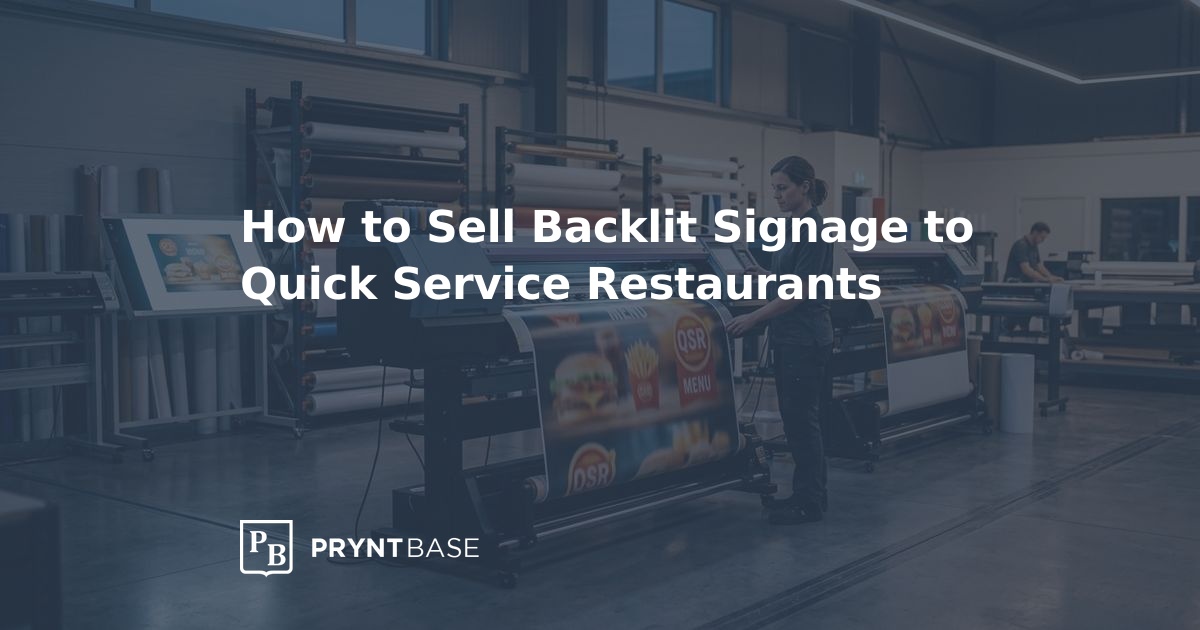
How to Sell Backlit Signage to Quick Service Restaurants
Walking into a local quick-service restaurant, or QSR, provides a clear view of where the high-margin opportunities live. While the floor graphics and window clings are steady bread-and-butter work, the backlit menu boards and promotional lightboxes represent the premium tier of wide-format production. For a print shop owner, these are not just another job on the schedule. They are technical products that require precise ink density, heat-resistant substrates, and a deep understanding of the customer's environment. Your estimator knows that the margin on a high-grade PET backlit film is significantly higher than a standard 13-ounce banner. However, selling these requires more than just a price list. You need to speak the language of the franchise owner who cares about brand consistency, durability under heat, and the visual pop that drives impulse buys at the point of sale. This guide focuses on the mechanics of the pitch, the technical specs that matter, and how to position your shop as the local expert for QSR signage.
The Technical Specs That Win QSR Trust
When you sit down with a franchise owner or a regional manager, they usually have a list of complaints about their current signage. It is often faded, warping from the heat of the menu board lamps, or the colors look washed out when the lights are turned on. This is your opportunity to talk about the mechanics of your production process. You are not just printing a file. You are engineering a visual display. To win the work, you must demonstrate that your press operator understands the nuances of backlit production.
A standard single-pass print often looks great on the table but fails the moment it is placed in a lightbox. The light washes out the blacks and desaturates the brand colors. To combat this, you should discuss your ability to run double-strike or high-density ink layers. This ensures that when the LEDs or fluorescent tubes kick in, the reds remain deep and the food photography looks appetizing rather than transparent.
Proper ink density is the difference between a menu board that looks professional and one that looks like a cheap home-office print.
Consider these technical points when discussing material options with a QSR prospect:
- Substrate Stability: Recommend 7-mil to 10-mil PET film rather than thin styrene. PET handles the internal heat of the lightbox without sagging or bowing over time.
- Light Diffusion: Explain the importance of a matte finish or a built-in diffusion layer. This prevents hot spots where the light bulbs are visible through the graphic.
- Ink Type: If you are running UV-curable or Latex, highlight the scratch resistance and the fact that these inks do not outgas or smell, which is critical in a food service environment.
- Color Calibration: Mention your use of spectrophotometers to ensure that the brand's specific corporate red matches across every franchise location.
Identifying and Reaching the Decision Makers
In the QSR world, the person who signs the checks is not always the person standing behind the counter. You have two primary targets: the independent owner-operator and the regional marketing director for a larger group. The independent owner is often frustrated by the slow turnaround times of the national corporate print provider and is looking for a local partner who can react quickly to limited-time offers. The regional director is looking for consistency and a way to reduce shipping costs across twenty or thirty locations.
You can use LeadsMagic to filter for food service businesses and hospitality groups within a fifty-mile radius of your shop. This allows you to build a targeted list of contacts who actually have the authority to switch vendors. When you reach out, do not lead with a generic pitch about quality. Lead with a specific observation about their current signage. If you noticed a faded board at their drive-thru, that is your entry point. Your message should focus on how your shop can improve their speed to market for seasonal menu changes.
Once you have their attention, use your shop's digital presence to reinforce your expertise. If you have written about wide-format technical specs using BlogMagic or shared recent install photos via SocialMagic, send those links to the prospect. It proves you have done this before and that you understand the specific requirements of the restaurant industry. You are moving the conversation away from price-per-square-foot and toward a discussion about brand value and operational reliability.
The Math of High-Margin Signage Sales
Every shop owner knows that the wide-format department can be a profit center or a bottleneck. The key to making backlit signage profitable is managing the prepress and the waste. Unlike a standard vinyl banner where a minor color shift might be acceptable, backlit graphics are unforgiving. This is why you must price these jobs correctly from the start. You are charging for the specialized material, the extra ink consumption of a double-strike print, and the expertise required to get the color right on the first pull.
When your estimator puts together a quote for a QSR, it should include more than just the print. Think about the following additions to your MIS quotes:
- On-site Audits: Charge a fee to visit the locations and measure the lightboxes. Many QSRs have older frames with non-standard dimensions.
- Installation Services: Do not just ship the film. Offer to have your team swap the graphics out during the restaurant's off-hours to ensure they are seated correctly in the frames.
- Kitting and Logistics: If you are handling multiple locations, provide a price for kitting the backlit film with other collateral like table tents or window clings.
- Rush Fees: QSRs often receive corporate assets at the last minute. Build a clear rush structure into your pricing for forty-eight-hour turnarounds.
Selling the installation alongside the print secures the account because you are solving a logistical headache for the manager.
By bundling the high-margin print with service-based line items, you protect your bottom line. You are no longer competing with online commodity printers who simply drop a tube in the mail. You are providing a complete signage solution that keeps their menu boards looking sharp and their drive-thru lines moving.
Overcoming Common Objections in the QSR Space
The most common objection you will hear is that corporate headquarters provides the signage. While this is true for many national chains, many franchises have the autonomy to source local print for regional promotions or to replace damaged boards. Your job is to be the backup plan that eventually becomes the primary partner. When they say corporate handles it, ask them how long it takes to get a replacement when a lightbulb heat-damages a panel. Usually, the answer is weeks. Your answer should be days.
Another objection involves the transition to digital menu boards. Many QSRs are moving to screens, but this transition is expensive and often takes years to roll out across an entire franchise group. Furthermore, many restaurants maintain static backlit boards for their drive-thru or as secondary displays even after the main boards go digital. Focus your pitch on the reliability of print. There are no software glitches, no dead pixels, and no high electricity costs with a well-printed backlit film.
Show them samples of your work next to their current boards. If you can show a side-by-side comparison where your print has better opacity and more vibrant highlights, the technical superiority of your shop becomes the closing argument. Use your MIS data to track which substrates are performing best in the field and share those success stories with your prospects. This operator-to-operator transparency builds a level of trust that a sales rep from a national conglomerate can never match.
Selling to QSRs is about understanding the high-stakes nature of their environment. Every hour a menu board is down or looks unprofessional, they are losing money. When you position your shop as the local expert who understands the technical requirements of high-density backlit printing, you move from being a vendor to a partner. Use your tools to find the right contacts, prove your expertise through your content, and price your work to reflect the specialized nature of the product. The margins are there for the shops that can execute the technical details and provide the level of service these fast-paced businesses require.