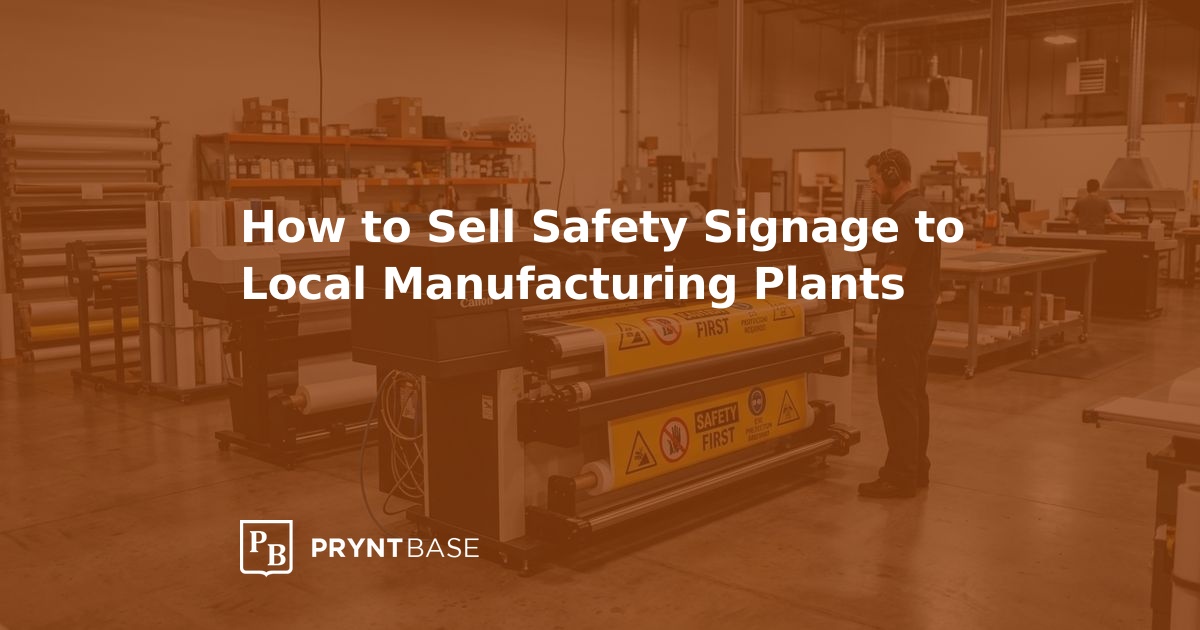
How to Sell Safety Signage to Local Manufacturing Plants
Walk onto any manufacturing floor and you will see it immediately. The environment is loud, the air smells of machine coolant, and every square inch of the facility is regulated by OSHA. For a print shop owner, these industrial parks are not just clusters of gray buildings. They are high-margin, recurring revenue goldmines. Unlike marketing departments that cut budgets during a recession, the safety department has a non-negotiable mandate to keep the facility compliant. If a warning label peels off a hydraulic press, it must be replaced. If a new walkway is painted, floor graphics must follow. This is not about selling pretty pictures. It is about selling compliance, liability protection, and worker safety. When you speak the language of a safety manager, you move away from being a commodity vendor and become a critical infrastructure partner. This guide will show you how to identify these opportunities, specify the right materials, and close the deal without competing on price.
Identifying the Safety Manager and Their Pain Points
In most print sales, you are hunting for the marketing director or the owner. In the industrial world, those people rarely care about signage. Your target is the Safety Manager, the EHS (Environment, Health, and Safety) Coordinator, or the Plant Manager. These individuals are not looking for a creative partner. They are looking for someone who understands ANSI Z535 standards and can deliver durable goods that won't fail in a high-heat or chemical-heavy environment.
Their biggest pain point is an audit. When an inspector walks the floor, missing or faded signage leads to heavy fines. You can use LeadsMagic within the Pryntbase platform to filter for local manufacturing, warehousing, and chemical processing plants. Once you have your list, your outreach should focus on risk mitigation. You are not asking if they need banners. You are asking if their current pipe markers and lockout-tagout stations are up to current compliance standards.
Consider these common industrial signage needs:
- Machine Guarding Labels: Small, high-tack decals that warn operators of pinch points or high voltage.
- Wayfinding and Floor Graphics: Heavy-duty, slip-resistant graphics that designate forklift lanes and pedestrian paths.
- PPE Reminders: Rigid signage at entry points requiring earplugs, safety glasses, or steel-toe boots.
- Pipe Identification: Wraps that color-code what is flowing through the facility, from high-pressure steam to caustic chemicals.
Substrates and Finishing for Industrial Durability
You cannot sell a standard vinyl sticker to a plant manager. If the adhesive fails due to machine vibration or oil exposure, you lose the account. Selling to manufacturing requires a deep understanding of your substrate cabinet and your wide-format capabilities. You need to talk about aggressive adhesives, UV-stable inks, and over-laminates that can withstand a power wash.
- Metal Substrates: For permanent outdoor or heavy-machinery mounting, 0.040 or 0.063 aluminum is the standard. It does not rust, and it handles extreme temperature shifts.
- Polycarbonate (Lexan): If you are printing overlays for control panels, polycarbonate is king. It is impact-resistant and can be printed on the second surface (the back) so the graphics never get scratched by greasy hands.
- High-Tack Vinyls: Standard permanent adhesive will fail on powder-coated metal. You need a high-tack, thick-mil vinyl specifically designed for low-VOC surfaces.
- Anti-Skid Laminates: For floor graphics, ensure your estimator is quoting an R10 or R12 rated laminate. Anything less is a slip hazard and a liability for your shop.
The secret to high margins in this niche is the specialized nature of the material, not the complexity of the design. You are often printing simple red, yellow, and black graphics, but the material cost and your expertise in selecting it justify the premium price. When you send an estimate through your MIS, be specific about the technical data sheets of the materials you chose. It shows the safety manager you are thinking about their liability.
The Site Audit as a Sales Strategy
The most effective way to close a manufacturing account is to offer a free Safety Signage Audit. This is not a high-pressure sales pitch. It is a walk-through of the facility with a notepad and a camera. You are looking for signs that are faded from UV exposure, labels that are peeling, or areas where the floor markings have been ground away by pallet jacks.
During the walk-through, ask the manager about their most recent safety inspection. Did the inspector flag anything? Are they adding new machinery soon? Every new piece of equipment requires a fresh set of localized safety instructions and warnings. If you use EmailMagic, you can send a follow-up sequence after the walk-through that includes photos of the non-compliant areas you found. Seeing a photo of a cracked, unreadable "Danger: High Voltage" sign makes the decision to buy an easy one for the manager.
During your audit, look for these specific high-value targets:
- Fire extinguisher locations that lack high-visibility 3D or projecting signs.
- Emergency eyewash stations where the signage is blocked or missing.
- Loading docks where the caution yellow paint on the edge is chipped and needs reflective tape or durable graphics.
- Confined space entries that are not clearly marked with OSHA-compliant headers.
Building a Recurring Revenue Loop
One-off sign orders are fine, but the real power of the industrial market is the repeat business. Manufacturing plants are living organisms. They move lines, they upgrade equipment, and they expand footprints. If you are the person who holds the art files for every machine label in the building, they will not go anywhere else. It is too much work for them to re-explain their specs to a different shop.
Establishing a recurring revenue stream with safety signage requires you to become the facility documentarian. Offer to keep a digital catalog of every sign in their plant. When a forklift hits a bollard and ruins a sign, the plant manager should be able to send you a quick text or email. Because you have the specs on file, you can have a replacement printed, laminated, and delivered within 24 hours. This level of service is what keeps the competition out.
You can use tools like SocialMagic to share case studies of local plants you have helped bring into compliance. Other plant managers in your area likely follow each other or participate in the same local manufacturing associations. Seeing a success story about a neighboring facility can trigger a cold lead to reach out for their own audit. Your goal is to move from a vendor who prints things to a consultant who manages the visual safety of the entire campus.
Selling to manufacturing plants is about reliability and technical knowledge. Your press operators know how to handle the files, and your wide-format gear is more than capable of hitting the spot colors required for ANSI standards. The gap is usually in the sales approach. Stop selling the print and start selling the peace of mind that comes with a perfectly compliant facility. When the safety manager knows they can pass an inspection because of your work, you have a customer for life.