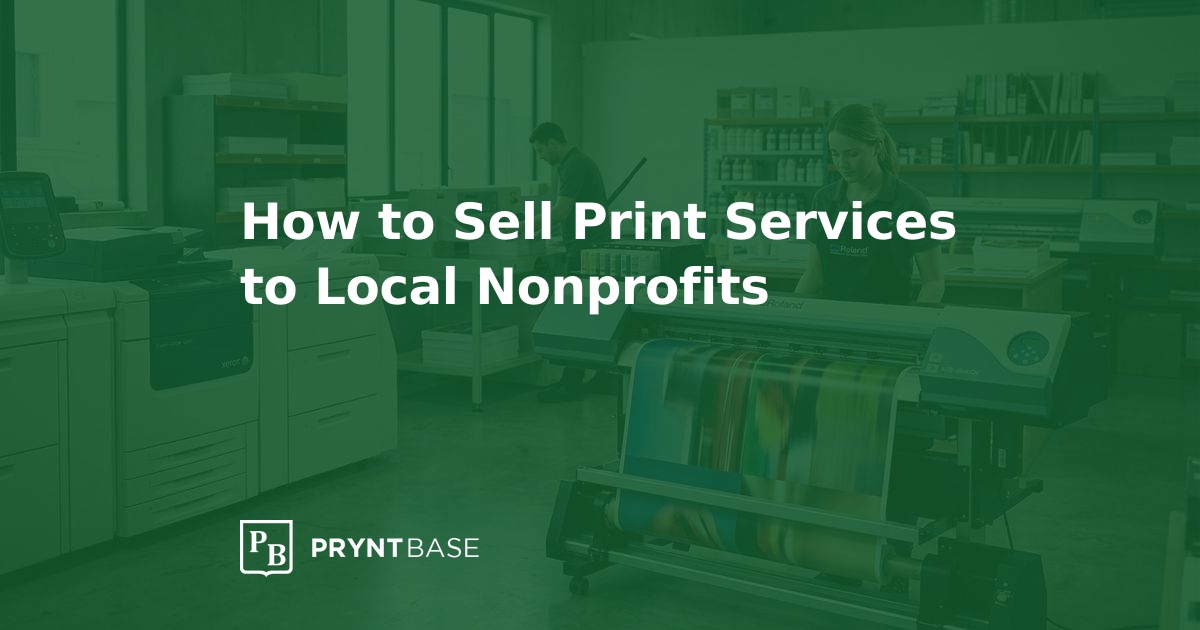
How to Sell Print Services to Local Nonprofits
Nonprofits are often viewed by print shops as price-sensitive customers looking for a discount. While their budgets are scrutinized by boards, the reality is that high-performing nonprofits are some of the most consistent, high-volume print buyers in any local market. They do not just need a flyer. They need complex direct mail sequences, event signage, and donor recognition materials that must meet strict brand standards. For a shop owner or sales rep, the secret to winning this business is not offering the lowest price per thousand. It is about understanding their donor cycle and the technical requirements of their mailings. When you talk to a development director, they do not care about your new five-color press. They care about their response rates and the postage savings you can find them through proper data hygiene. By positioning your shop as a technical consultant rather than a commodity vendor, you can secure recurring revenue that fills your production schedule year after year.
Identifying the High-Volume Nonprofit Opportunities
Not every nonprofit is a fit for a commercial print shop. The local PTA might need fifty copies once a year, which barely covers your setup time. To build a profitable vertical, you must target organizations with dedicated development or fundraising departments. These teams have annual budgets and specific targets for donor acquisition. You can use tools like LeadsMagic to identify local organizations that are growing or running active campaigns. When you analyze a potential lead, look for these specific indicators of high print volume:
- Educational Institutions: Private schools and community colleges have constant needs for recruitment brochures, alumni magazines, and endowment fund appeals.
- Healthcare Foundations: Hospital systems often have foundations that run massive annual galas and capital campaigns requiring high-end finishes like spot UV or foil stamping.
- Arts and Culture: Museums, theaters, and orchestras require seasonal programs, membership kits, and large-scale environmental graphics for new exhibits.
- Regional Social Services: Food banks and housing charities often rely on high-frequency direct mail to maintain their monthly giving programs.
The key is to look for the mail volume. If an organization is sending out thousands of appeal letters a month, they are dealing with postage, data lists, and mail house logistics. That is where your expertise as an operator becomes their greatest asset. The goal is to move from being a commodity printer to a strategic partner that understands their fiscal year and donor cycles.
Packaging the Annual Appeal for Recurring Revenue
The annual appeal is the bread and butter of nonprofit printing. Instead of quoting a single letter, propose a comprehensive package that covers their entire year-end giving season. This allows your estimator to build a more accurate quote and helps your press operator plan for longer runs. A standard appeal package should include:
- The Outer Envelope: Usually a #10 or 6x9 envelope with a teaser headline and a pre-printed indicia.
- The Appeal Letter: Often a two-page or four-page letter with variable data fields for the donor's name, last gift amount, and suggested next gift.
- The Remit Envelope: A #6.75 or #9 envelope, often with a moisture-activated adhesive or fugitive glue for easy sealing.
- The Insert: A small buckslip or brochure highlighting a specific success story to create an emotional connection.
When you discuss these packages, focus on the technical execution. Mention how you handle NCOA (National Change of Address) updates to reduce undeliverable mail. Explain how your digital press can handle variable data printing (VDP) to personalize every single piece without slowing down the production line. Variable data is the most powerful tool in your shop for increasing nonprofit response rates and proving your value as a consultant. Using SEOMagic to highlight these specific mailing services on your website can help attract development directors who are searching for local mail house expertise.
Maximizing Revenue with Wide-Format and Event Graphics
Nonprofits live and die by their events. Whether it is a 5K run, a black-tie gala, or a golf tournament, these events require a massive amount of physical collateral. This is where your wide-format department can shine. While the direct mail keeps the offset or digital presses busy, the event season keeps your flatbed and roll-to-roll printers running. You should offer a standardized event kit that includes everything they need for a successful day.
Think about the logistics of a gala. They need step-and-repeat banners for the red carpet, foam core directional signage for the venue, and retractable banners for the silent auction tables. They also need printed programs with high-quality saddle stitching and perhaps a soft-touch lamination on the cover to give it a premium feel. When you bundle these items, you simplify their procurement process. Instead of managing five different vendors, they have one point of contact who understands their brand colors across different substrates. If you are using SocialMagic to showcase your work, post photos of these completed event setups. Seeing a fully branded ballroom is much more persuasive to a nonprofit board than seeing a photo of a printing press.
Navigating the Board and Approval Process
Working with nonprofits often means dealing with multiple stakeholders. A development director might love your work, but the board of directors or a volunteer committee might have the final say. This can lead to long proofing cycles and multiple revisions. To protect your margins, you must have a clear process for approvals. Use your MIS to track every revision and ensure your proofs are clearly marked. If they require a physical press proof, make sure the cost is built into the initial estimate.
You can use EmailMagic to send automated updates to your nonprofit clients, keeping them informed of where their job is in the production queue. This level of transparency builds trust with board members who are often nervous about spending donor money. Explain the importance of paper weights and finishes in a way that relates to their brand. For example, a heavy, textured cover stock conveys stability and longevity for an endowment report, while a recycled house sheet might be better for an environmental charity that wants to show they are being responsible with their resources. When you speak their language, you become an extension of their team rather than just another line item in their budget.
Selling to nonprofits requires a shift in mindset from chasing one-off jobs to managing long-term cycles. By focusing on high-volume organizations, packaging their annual appeals, and dominating their event signage needs, you create a stable base of recurring revenue. These clients value reliability and technical proficiency above all else. When you deliver a complex variable data mailing on time and under the postage budget, you have earned a client for life. Focus on the mechanics of their success, and the growth of your shop will follow naturally.