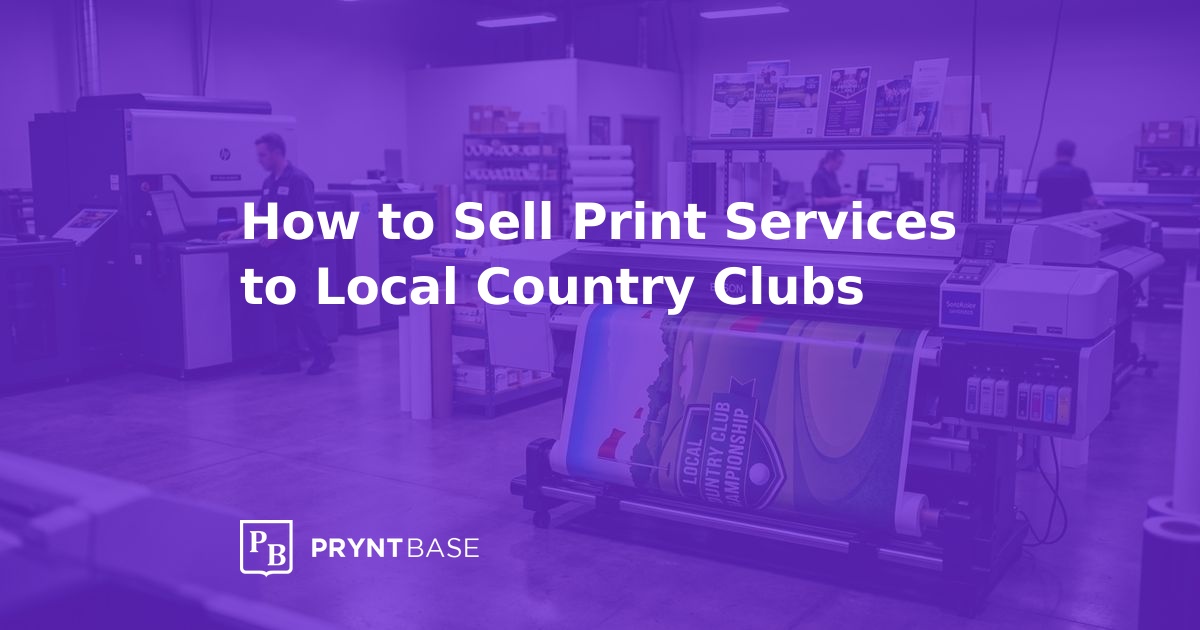
How to Sell Print Services to Local Country Clubs
In the print industry, we often spend too much time chasing high-volume, low-margin commodity work that barely keeps the lights on. While a 50,000-piece postcard run for a national brand keeps the presses spinning, the razor-thin margins leave little room for error in the finishing department. If you want to improve your shop's bottom line, you need to look at local country clubs. These organizations are unique because they operate like a hybrid of a luxury hospitality brand and a high-end events venue. They aren't looking for the absolute lowest price on the internet. They are looking for a reliable partner who understands their aesthetic and can handle everything from premium, wire-bound membership directories to weather-resistant tournament signage. When you walk into a country club, you aren't just selling paper and ink. You are selling the professional image of the club to its members and donors. This guide breaks down the specific technical opportunities and sales strategies to win these accounts.
Identifying the High-Margin Product Mix
Country clubs require a specific set of printed materials that play to the strengths of a full-service commercial shop. Unlike a standard retail business, their needs are split between daily operations and seasonal events. To get your foot in the door, you should lead with these three high-value categories:
- Membership Directories: These are the crown jewels of club printing. Typically, these are produced annually or bi-annually. Use a heavy 100lb or 120lb cover stock with a soft-touch aqueous coating or a matte lamination. For the guts, an 80lb or 100lb dull-coated text stock provides a premium feel without the glare. Wire-O or plastic coil binding is preferred over saddle-stitching because it allows the directory to lay flat on a desk or in a golf cart.
- Waterproof Menus and Scorecards: The clubhouse restaurant and the beverage carts need menus that can survive spills and humidity. Synthetic stocks like Teslin or Yupo are excellent choices here because they are tear-proof and waterproof without the need for edge-seal lamination. For scorecards, an uncoated 100lb or 120lb cover stock is essential so members can easily write on them with a pencil.
- Direct Mail Membership Drives: When a club needs to fill its roster, they don't use cheap flyers. They use invitation-style direct mail. Think A7 envelopes with matching 80lb felt or linen cards. The key to winning this work is offering a turnkey solution that includes list management and variable data printing for a personalized touch.
Winning the Tournament Signage Contract
Tournament season is the most lucrative time for any print shop servicing a golf club. Between member-guest tournaments, charity scrambles, and corporate outings, the demand for wide-format printing is massive. This is where your estimator can really shine by creating bundled packages. A standard tournament kit should include several distinct components that keep your flatbed printer and digital cutters busy.
- Tee Signs: These are typically 18x24 or 12x18 4mm Coroplast signs with H-stakes. However, you can upsell to 3mm PVC for a smoother finish if the tournament is a high-end corporate event.
- Sponsor Banners: Most tournaments require a 3x8 or 4x10 foot banner for the registration area. Use a 13oz scrim vinyl for durability, and make sure your grommet placement is precise to avoid sagging.
- A-Frame Inserts: For the putting green or the clubhouse entrance, 24x36 Coroplast inserts for plastic A-frames are the industry standard.
- Step-and-Repeat Backdrops: The post-round dinner usually includes a photo op. A 10x8 foot fabric or vinyl backdrop on a telescopic stand is a high-margin item that adds significant professional value to the event.
When you are pitching these kits, don't just talk about the price per sign. Talk about your ability to manage the sponsor logos. Offer to provide a template that the tournament coordinator can send to sponsors to ensure the files are print-ready. This reduces the time your prepress department spends fixing low-resolution JPEGs. If you are looking for new clubs to target, you can use LeadsMagic to identify country clubs and private golf courses within your delivery radius and see who the key decision-makers are.
Navigating the Club Hierarchy
One of the biggest mistakes print reps make is trying to sell to the person at the front desk. In a country club environment, the decision-making is often decentralized. The General Manager (GM) usually handles the big-picture items like annual directories and membership drives. The Head Golf Professional or the Tournament Director handles the wide-format signage for events. Finally, the Food and Beverage (F&B) Manager handles the menus and table tents.
Your goal is to become the preferred vendor for the entire facility by solving a specific problem for one department first. Often, the easiest entry point is the Head Pro. They are usually overwhelmed during tournament season and are looking for someone who can take the signage headache off their plate. If you can prove that you can take a list of sponsor names and turn them into 18 perfect tee signs by Friday morning, you have earned the right to talk to the GM about the membership directory.
When reaching out, avoid generic sales pitches. Use EmailMagic to craft professional, operator-to-operator messages that focus on your technical capabilities and reliability. Mention your specific equipment, like your new wide-format flatbed or your high-speed digital press, to signal that you have the capacity to handle their peak season demands without missing a deadline.
Streamlining the Order and Proofing Process
Country club staff are rarely print experts. They will send you files in Word, Publisher, or even PowerPoint. If your shop can offer a simple online ordering and proofing experience, you will win their loyalty forever. They don't want to deal with a complex MIS interface. They want to upload a logo, see a digital proof, and know that the job is in the queue.
This is where your internal systems matter. When you receive an order for 100 member handbooks, your team should be checking paper availability immediately. Using StockMagic allows you to keep an eye on your inventory of high-end specialty papers, so you don't promise a specific linen stock that is currently on backorder from the merchant. Being proactive about substrate availability builds trust with the GM, who likely has a board of directors to answer to regarding the club's budget and timeline.
Finally, consider the delivery. Most country clubs have a specific receiving area or a pro shop. Don't just drop the boxes and leave. If you are delivering tournament signs, offer to help them organize the signs by hole number. This small level of service, which takes your driver an extra ten minutes, separates you from the online giants who just ship a box of signs that the Head Pro then has to sort through manually.
Building a book of business with local country clubs is about consistency and technical excellence. Start by identifying the clubs in your area that host major annual events and reach out with a specific offer for tournament signage or a sample of a premium membership directory you have produced for another client. Once you land that first order, the recurring nature of club operations will provide a steady stream of high-margin work for your shop year after year. Focus on the details of the stock, the precision of the finishing, and the reliability of your delivery, and you will find that these clients are some of the most profitable in your portfolio.