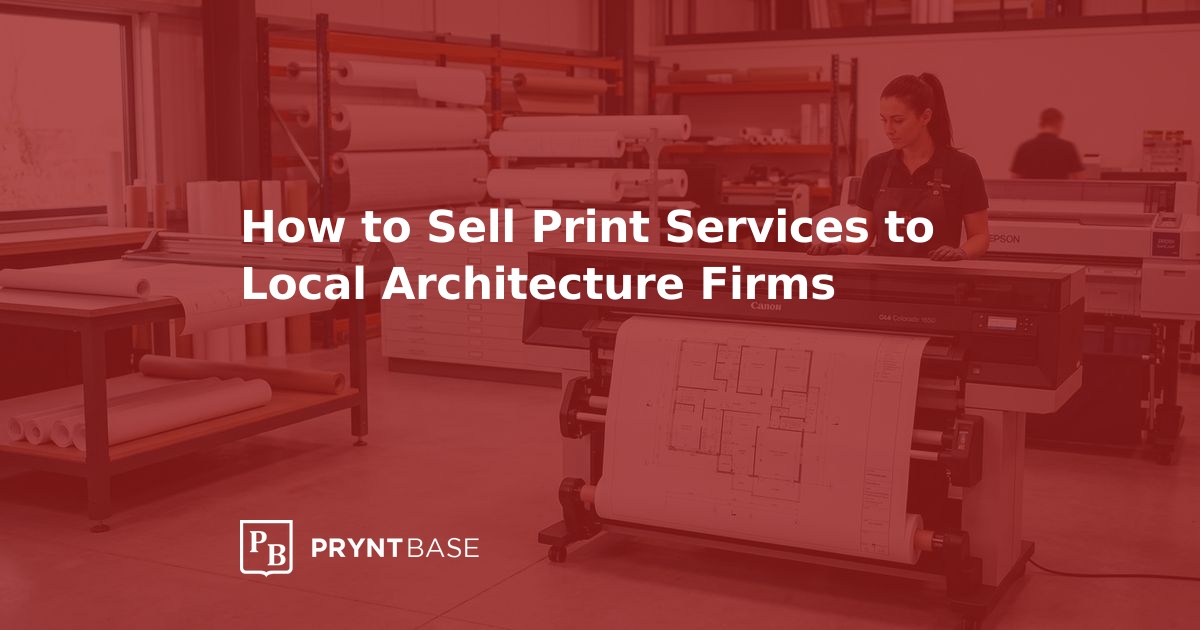
How to Sell Print Services to Local Architecture Firms
Architecture firms represent some of the most consistent, high-margin revenue streams available to a local commercial printer. Unlike retail customers who might quibble over the price of a hundred business cards, architects value precision, reliability, and speed above all else. They are professional buyers who understand that a missed deadline for a bid set can cost their firm a multi-million dollar contract. For your shop, this means the relationship is built on technical capability rather than just the lowest price on a spreadsheet. Whether you are running a late-model wide-format inkjet or a high-speed toner-based plotter, these firms need your expertise to translate digital BIM models into physical presentation materials. To win this business, you have to speak their language. You need to understand the difference between a preliminary draft and a final submittal set. This guide focuses on the mechanics of the sale, from identifying the right stakeholders to ensuring your estimator understands the specific requirements of architectural substrates and finishing.
Identifying the Most Profitable Architecture Accounts
Not every firm with an architect's license is a prime target for your shop. Residential architects often have smaller print needs and may even rely on high-end desktop plotters for their daily work. The real opportunity lies with commercial firms, urban planners, and landscape architects who handle large-scale municipal or private developments. These firms generate a high volume of wide-format output and require professional binding for their project manuals and RFP responses.
- Commercial Architecture Practices: These firms handle office buildings, retail centers, and industrial parks. Their volume of revisions is high, meaning more clicks for your wide-format devices.
- Government and Municipal Contractors: These offices must adhere to strict submittal guidelines. They often need multiple sets of 24x36 or 30x42 drawings, often on short notice.
- Interior Design and High-End Residential: While the volume of drawings might be lower, their need for high-quality, color-accurate presentation boards is significant. This is where your flatbed printer or high-end aqueous inkjet pays for itself.
- Urban Planning Firms: These accounts often require massive site maps and vinyl banners for public hearings and community meetings.
To find these prospects, you do not need to rely on cold calling the front desk. Tools like LeadsMagic can help you identify local firms that are winning contracts or expanding their headcount. Once you have a list, your goal is to find the office manager, the project coordinator, or the junior associate tasked with managing the submittal process. These are the people who feel the pain when a plotter goes down or a deadline is looming.
The Technical Specs That Matter to Architects
When you sit down with a principal architect or a production manager, do not talk about your marketing awards. Talk about your equipment and your quality control processes. They want to know that your RIP can handle complex transparency in CAD files without crashing. They care about line weight consistency and whether your wide-format bond paper is the right weight for field use. Reliability in architectural printing is measured by the accuracy of the scale, not just the brightness of the ink.
You should be prepared to discuss your shop's ability to handle various file types beyond just PDFs. While PDF is the standard, knowing how to handle DWG or Revit exports can set you apart. Ensure your pre-flight team understands how to check for missing fonts or line styles that did not embed correctly. If your press operator can catch a scaling error before the job hits the substrate, you have saved the architect a massive headache and potentially thousands of dollars in construction errors. This level of technical oversight is what allows you to charge a premium over the local big-box copy shop.
Streamlining the Bid Set and Submittal Workflow
The core of the architecture print business is the bid set. This is a coordinated package of drawings and specifications that contractors use to price a job. The workflow is often frantic and involves last-minute changes. To secure this business, your shop must be positioned as a seamless extension of their office.
- Establish a Dedicated Upload Channel: Do not make them use generic file transfer sites. Provide a dedicated portal or an integrated MIS link where they can drop files and specify quantities.
- Offer Proofing for Renderings: For high-stakes presentations, offer a small-scale color proof. Architects are particular about the exact shade of a glass curtain wall or a brick facade.
- Standardize Your Finishing: Be the expert in binding. Whether it is screw-post binding for thick sets or wire-o for project manuals, have samples ready to show how your finishing improves their professional image.
- Implement a Rush Protocol: Architecture is a deadline-driven industry. Clearly define your rush fees and after-hours capabilities so the firm knows exactly what to expect when they are working late on a submittal.
By standardizing these steps, you reduce the burden on your estimator and production team. When the process is predictable, your margins stay healthy even when the turnaround time is tight. Your shop becomes an extension of their studio when you anticipate their submittal deadlines before they even send the files.
Marketing Collateral and High-End Presentation Materials
While blueprints and plan sets provide the volume, marketing collateral provides the margin. Architecture firms are constantly pitching for new business. They need high-end portfolios, leave-behind brochures, and large-format boards for interviews. This is where your digital press and wide-format finishing capabilities shine. Use your MIS to track when a firm orders plan sets for a specific project, then follow up with an offer to print the presentation materials for the grand opening or the client pitch.
Consider offering specialized substrates like Gatorplast or foam core with a matte lamination to prevent glare during presentations. If you have a flatbed cutter, you can offer custom-shaped displays or architectural models mounted on rigid boards. Use EmailMagic to send targeted samples of these high-end products to your existing architecture contacts. Showing them a physical sample of a soft-touch aqueous coating or a spot UV effect on a portfolio cover can trigger a sale that they had not even considered. Many architects are unaware of the advancements in digital embellishment, and seeing these techniques in person can move them away from standard, boring presentations.
Using Local Authority to Close the Deal
In the print industry, reputation is everything. Architects talk to one another, and they talk to the general contractors who build their designs. If you become the go-to shop for one major firm in town, others will follow. To build this local authority, your online presence must reflect your specialized knowledge. Using tools like BlogMagic or SEOMagic can help you create content that speaks directly to the architectural community, such as articles on the best substrates for construction site signage or how to prepare files for large-scale urban planning maps.
When you prospect, mention the specific challenges you have solved for other firms. If you helped a firm meet a 4:00 AM deadline for a city council meeting, tell that story. This is not about hype, it is about demonstrating a mechanical understanding of their business needs. Once you have their trust, you can utilize SocialMagic to stay top-of-mind by sharing photos of completed presentation boards or high-volume plan sets moving through your shop. This visual proof reinforces your capability and keeps your shop in their mental rolodex for the next big project.
Building a book of business with local architecture firms requires a shift from being a vendor to being a partner. It starts with understanding their technical requirements and ends with a workflow that respects their deadlines. By focusing on the specific products they need, from bond plan sets to high-end presentation boards, and using the right prospecting and marketing tools to reach them, you can secure a stable and profitable revenue stream that will sustain your shop for years to come. Focus on the mechanics of their success, and your own shop's growth will follow naturally.