How to Sell More Print to Local Political Campaigns
Every election cycle brings a predictable surge in demand that can either overwhelm your production floor or pad your bottom line with high-margin, high-volume work. For the average print shop owner, local political campaigns represent some of the most reliable seasonal revenue available. These candidates are not looking for complex brand strategy. They need physical presence and they need it yesterday. They need their name on every street corner, their platform on every doorstep, and their face in every mailbox. When you approach these accounts as a partner who understands their tight deadlines and specific substrate needs, you move from being a commodity vendor to a critical campaign infrastructure provider. This post focuses on the mechanics of winning these bids by bundling core products like yard signs, door hangers, and direct mail into a cohesive package that solves the candidate's biggest problem: getting noticed before the polls open. By preparing your estimators and press operators now, you can capture this revenue without disrupting your existing commercial accounts.
Building the Candidate Starter Kit
Local candidates often start with very little infrastructure. Whether they are running for school board or city council, they need a standard set of materials to establish legitimacy. Instead of quoting individual items, your sales team should lead with a bundled starter kit. This simplifies the decision-making process for the campaign manager and ensures you capture the entire spend rather than just the wide-format work.
A high-value political bundle typically includes:
- Yard Signs: 24x18 4mm Coroplast signs printed with UV-curable inks for weather resistance. Always include the H-stakes in the quote to provide a turnkey solution.
- Door Hangers: 3.5x8.5 or 4.25x11 on 100lb gloss cover. These are essential for block-walking efforts and provide high visibility at a low unit cost.
- Palm Cards: 4x6 or 5x7 heavy cardstock, often 14pt or 16pt with a matte or UV coating. These are the primary leave-behind for events and meet-and-greets.
- Direct Mailers: 6x9 or 6x11 postcards designed for EDDM or targeted voter lists.
Standardizing these specifications allows your estimator to produce quotes in minutes rather than hours, which is vital when a candidate is shopping around.
Timing Your Outreach with LeadsMagic
In political printing, the early bird does not just get the worm. The early bird secures the budget before it is spent elsewhere. If you wait until you see opponent signs on the road, you have already lost the opportunity. You must track filing deadlines at the county and city levels to know exactly who is running the moment they become official.
- Monitor local election boards for the list of certified candidates. This data is public and usually updated weekly during filing periods.
- Segment your outreach based on the race. Small town races might only need signs and hangers, while county-wide races will require heavy direct mail support.
- Utilize LeadsMagic to identify and organize these new prospects. Having a centralized way to track who has been contacted and what their specific needs are prevents your sales reps from doubling up on the same candidate.
- Send a physical sample pack. Nothing sells print like print. A folder containing a sample door hanger, a palm card, and a photo of a high-quality yard sign shows the candidate exactly what their brand will look like in the field.
Optimizing the Production Floor for Speed
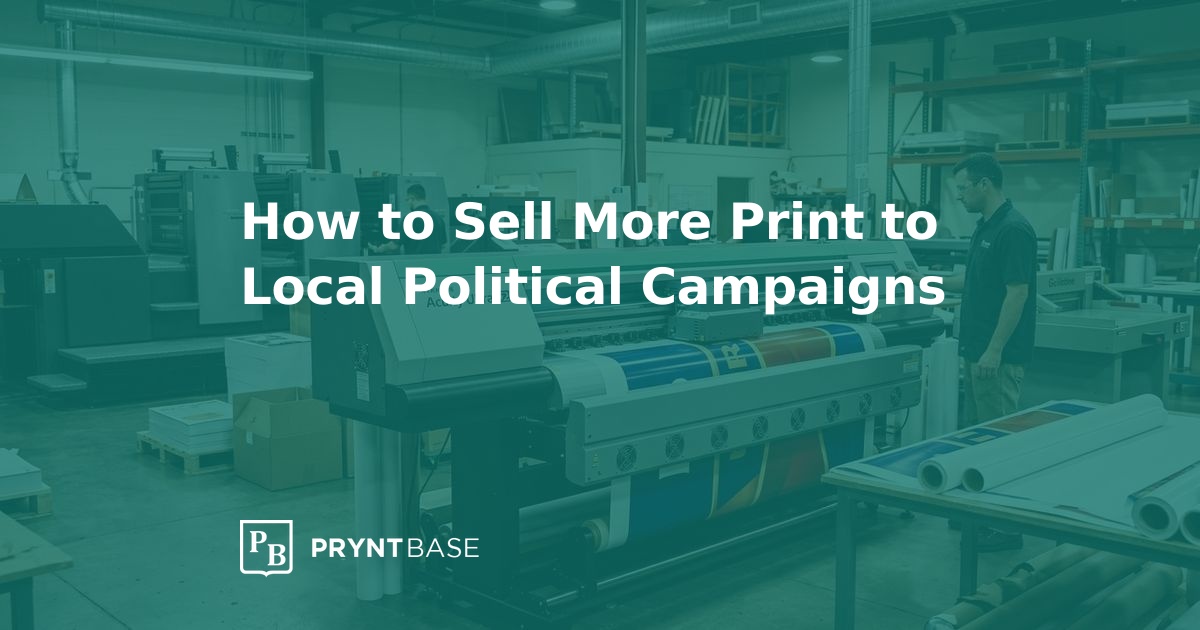
Political work is notorious for being last-minute. A candidate sees their opponent’s new banner at a parade and suddenly they need five of their own by Friday. To handle this without crashing your shop, you need to look at your workflow and finishing departments. If your wide-format flatbed is already at capacity, you need to know your trade-only partners who can take the overflow for Coroplast work.
Efficiency on the floor comes down to gang-run printing and inventory management. Use StockMagic to ensure you have pallets of 4mm white Coroplast and H-stakes on hand before the peak season hits. Running out of substrate in the middle of October is a mistake you only make once. For digital presses, keep a healthy supply of 100lb gloss cover and 14pt C2S for those quick-turn palm cards and hangers.
Managing the production queue requires a firm hand, especially when every candidate claims their job is the highest priority. Use your MIS to track real-time capacity and set clear expectations on turnarounds. If you can guarantee a 48-hour turn on yard signs while the competition is quoting a week, you can command a premium price.
The Direct Mail and Voter Data Component
Direct mail remains the most effective way for a local candidate to reach specific demographics. To sell more mail, you must speak the language of the campaign manager. They are looking for Every Door Direct Mail (EDDM) for broad geographic coverage or targeted lists for specific party affiliations. If your shop can handle the data processing, NCOA, and presorting in-house, you become an indispensable asset.
When discussing mail with a candidate, focus on these technical aspects:
- Targeting: Explain the difference between mailing every household and mailing only frequent voters.
- Postage Savings: Show them how your mail prep services can lower their per-piece cost, allowing them to send more mailers for the same budget.
- Turnaround: Explain the path from the press to the Post Office. Candidates are often surprised by the three to five days required for delivery after the job leaves your dock.
By using SocialMagic to share case studies of successful mail campaigns, you can educate potential candidates on the impact of a well-executed mail strategy before they even walk through your door. It builds authority and shows that you understand the nuances of postal regulations and voter behavior.
Financial Reality and Payment Terms
There is a specific rule in political printing that every veteran shop owner knows: get paid upfront. Political campaigns are temporary entities. Once the election is over, the campaign committee often dissolves, and if they lost, their motivation to pay outstanding invoices disappears along with their budget. Your estimator should always require a 100% deposit before plates are made or files are ripped to the digital front end.
This is not being difficult. It is standard industry practice. Explain to the candidate that due to the rapid turnaround and the custom nature of the work, payment is required at the time the order is placed. This protects your cash flow and ensures that your press time is being used for accounts that are fully funded. If they cannot pay upfront, they are likely a credit risk you do not want to take on during your busiest season.
Selling to local political campaigns is a specialized discipline that requires a mix of aggressive outreach, tight production control, and sensible financial policies. By positioning your shop as the expert in bundled candidate kits and rapid-response direct mail, you can capture a significant share of the local election spend. Use the tools at your disposal, from LeadsMagic for prospecting to StockMagic for inventory control, to ensure your shop is the go-to resource for every name on the ballot. When you provide a seamless experience for a candidate during the high-stress environment of an election, you often win a commercial customer for life once the campaign is over. Focus on the mechanics of the print, the speed of the delivery, and the clarity of the quote, and you will see your seasonal revenue hit new heights.